
"The Cholangiocarcinoma Research Institute, in collaboration with Regional Health Office 7, organized a leadership camp for change in Kudrang District, Maha Sarakham Province, aiming to make it a model district for addressing OV-CCA (Bile Duct Cancer-Cancerous Arthritis) problems."
- January 28, 2025
- admin
- 0
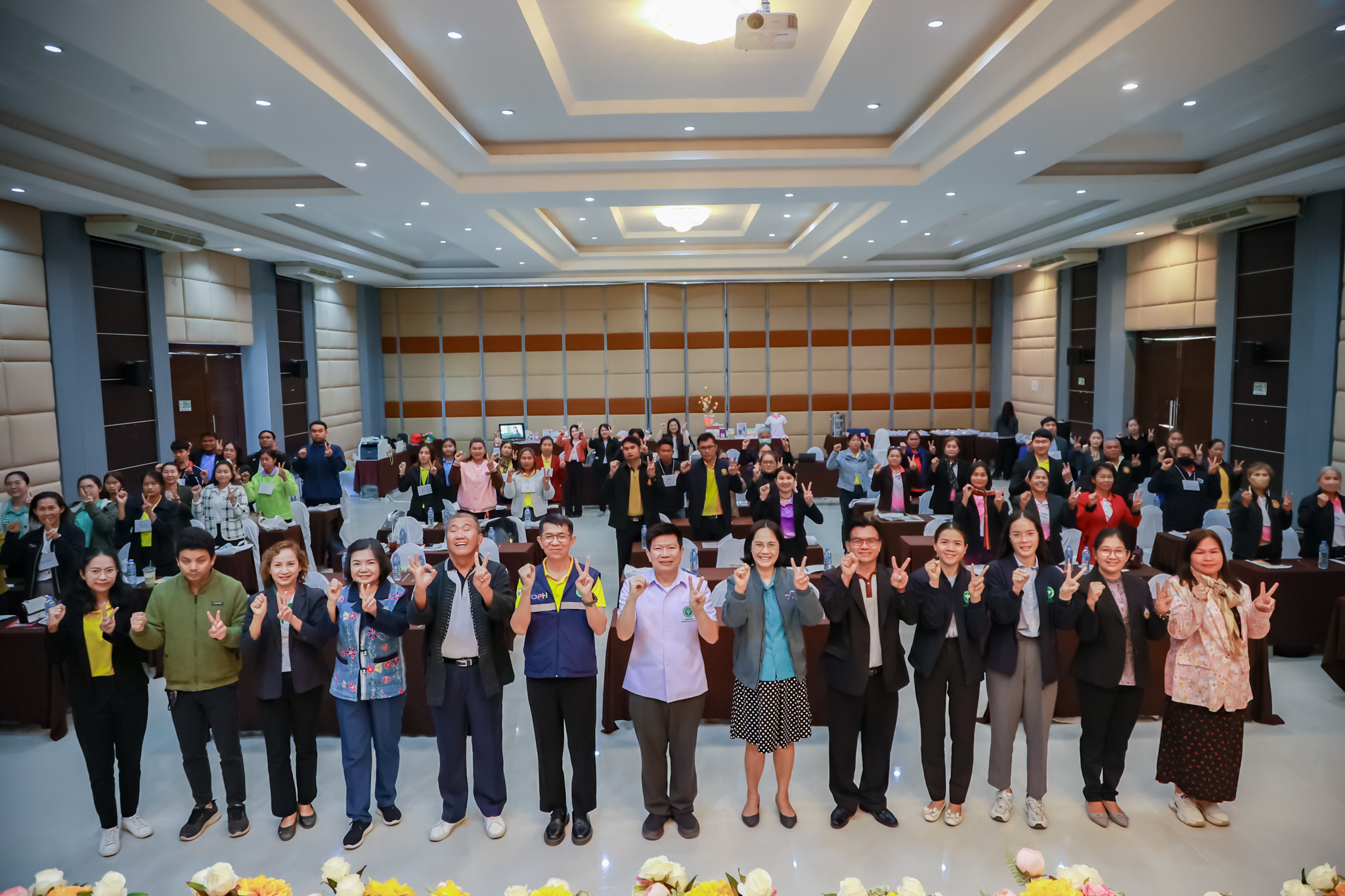
"The Cholangiocarcinoma Research Institute, in collaboration with Regional Health Office 7, organized a leadership camp for change in Kudrang District, Maha Sarakham Province, aiming to make it a model district for addressing OV-CCA (Bile Duct Cancer-Cancerous Arthritis) problems."
On January 23-24, 2025, the Cholangiocarcinoma Research Institute, led by Assoc. Prof. Dr. Wacharin Loylom, Director of the Institute, in collaboration with the Office of Disease Prevention and Control Region 7, Khon Kaen (ODPC 7 Khon Kaen), organized the “Leadership Camp for Change to Solve the Problem of Liver Fluke Disease and Cholangiocarcinoma.” Dr. Hirunwut Phraekuntham, Acting Director of ODPC 7 Khon Kaen, presided over the opening ceremony, and Dr. Hatcha Nueythong, Deputy Provincial Public Health Officer of Maha Sarakham, also attended the ceremony at the S-Tawan Hotel, Maha Sarakham Province.
This leadership camp project aims to cultivate leaders to address the problems of liver fluke disease and cholangiocarcinoma in Kudrang District, Maha Sarakham Province. Participants come from five sub-districts: Kudrang, Napho, Loengfaek, Nongwaeng, and Huai Toei, and include village health volunteers, sub-district health promotion hospital staff, community leaders, village headmen, representatives from local administrative organizations, and teachers, totaling over 60 people.
The camp activities included strengthening teamwork processes, leadership, enhancing self-expression and presentation skills, and providing educational lectures on solving liver fluke disease and cholangiocarcinoma. Distinguished speakers covered topics such as: the problems of liver fluke disease and cholangiocarcinoma and the transmission pathways of liver fluke infection to cholangiocarcinoma; the severity of cholangiocarcinoma and the importance of liver fluke prevention; innovative liver fluke screening methods; problems and solutions for liver fluke disease and cholangiocarcinoma in Kudrang District; promoting sanitation and waste management in the area; promoting parasite-free fermented fish establishments for liver fluke prevention; and providing youth with immunization training against liver fluke disease and cholangiocarcinoma.
Next, the problem was analyzed using the problem tree tool. Practical training was provided in developing an outcome plan, and guidelines for implementing that plan were created. This led to concrete approaches, projects, and activities that can be used to address the problems of liver fluke disease and cholangiocarcinoma in Kudrang District.
This leadership camp project aims to cultivate leaders to address the problems of liver fluke disease and cholangiocarcinoma in Kudrang District, Maha Sarakham Province. Participants come from five sub-districts: Kudrang, Napho, Loengfaek, Nongwaeng, and Huai Toei, and include village health volunteers, sub-district health promotion hospital staff, community leaders, village headmen, representatives from local administrative organizations, and teachers, totaling over 60 people.
The camp activities included strengthening teamwork processes, leadership, enhancing self-expression and presentation skills, and providing educational lectures on solving liver fluke disease and cholangiocarcinoma. Distinguished speakers covered topics such as: the problems of liver fluke disease and cholangiocarcinoma and the transmission pathways of liver fluke infection to cholangiocarcinoma; the severity of cholangiocarcinoma and the importance of liver fluke prevention; innovative liver fluke screening methods; problems and solutions for liver fluke disease and cholangiocarcinoma in Kudrang District; promoting sanitation and waste management in the area; promoting parasite-free fermented fish establishments for liver fluke prevention; and providing youth with immunization training against liver fluke disease and cholangiocarcinoma.
Next, the problem was analyzed using the problem tree tool. Practical training was provided in developing an outcome plan, and guidelines for implementing that plan were created. This led to concrete approaches, projects, and activities that can be used to address the problems of liver fluke disease and cholangiocarcinoma in Kudrang District.