
The National Research Council of Thailand (NRCT) and STS forum presented research on "Smart Healthcare and Advanced Therapy" at the "STS forum Japan-Thailand Symposium 2026," challenging the advancement of smart healthcare systems and advanced treatments.
- April 29, 2026
- admin
- 0
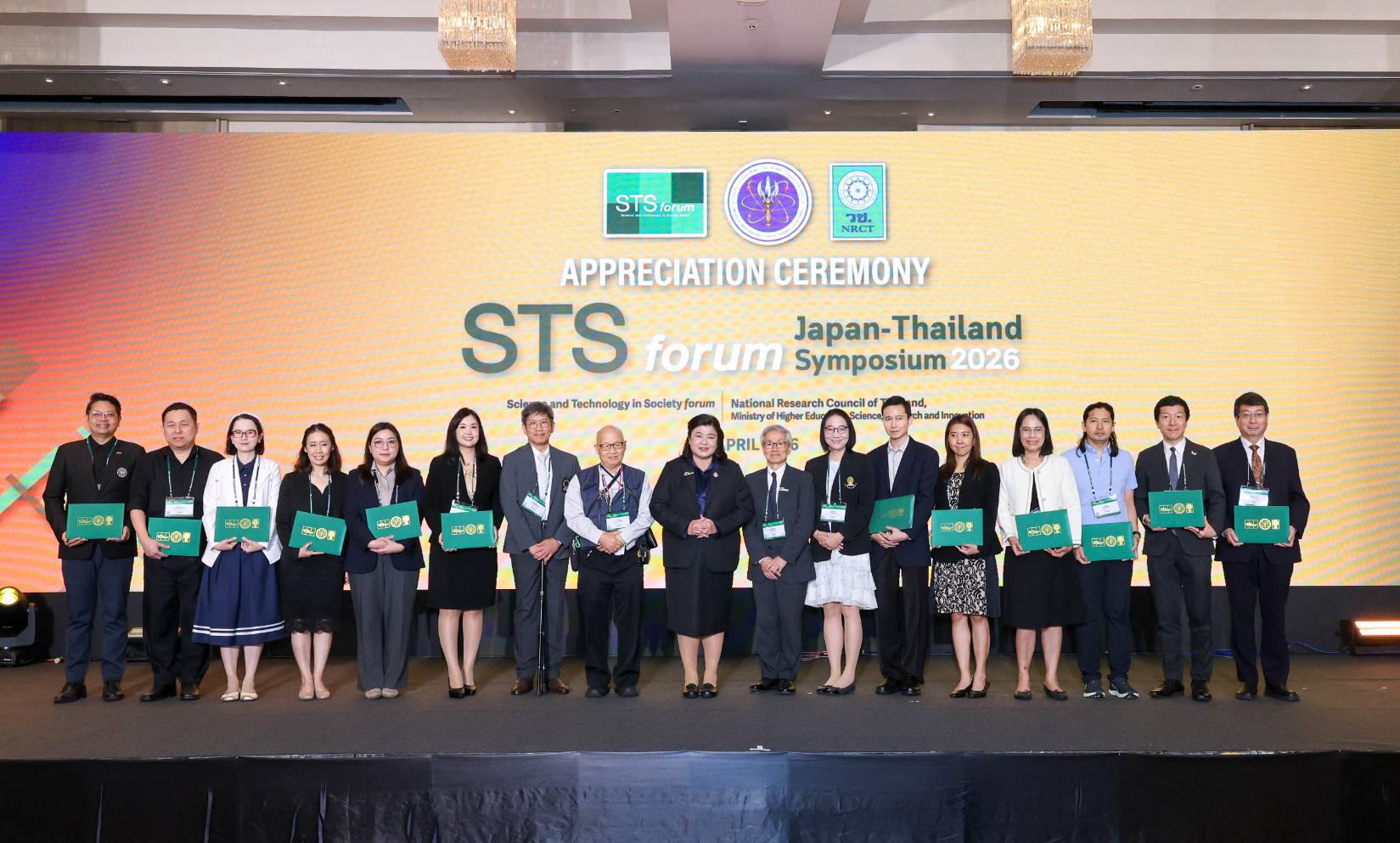
The National Research Council of Thailand (NRCT) and STS forum presented research on "Smart Healthcare and Advanced Therapy" at the "STS forum Japan-Thailand Symposium 2026," challenging the advancement of smart healthcare systems and advanced treatments.
On April 25, 2026, the National Research Council of Thailand (NRCT), Ministry of Higher Education, Science, Research and Innovation, in collaboration with the Science and Technology in Society Forum (STS Forum) of Japan, presented research on the topic of “Smart Healthcare and Advanced Therapy” at the “STS Forum Japan-Thailand Symposium 2026” held at the World Ballroom B, 23rd floor, Centara Grand and Bangkok Convention Centre, CentralWorld, Bangkok. The event aimed to strengthen international cooperation in academic and technological advancements in modern medicine.
In this ceremony, Dr. Wiparat Dee-ong, Director of the National Research Council of Thailand, presided over the welcoming remarks, presented plaques and certificates of appreciation to the special lecturers, experts, moderators, and presenters.
Dr. Wiparat Dee-ong stated that the STS Forum Japan-Thailand Symposium 2026 focused on the theme of "The Great Convergence: AI-Driven Health, Environment and Bio-Economy," ushering in a new era of public health powered by AI. The symposium served as a platform for exchanging research findings and perspectives from global experts, emphasizing the use of scientific and innovative advancements to address complex challenges in public health, environmental sustainability, climate change, and energy security. It highlighted the importance of Artificial Intelligence (AI), Advanced Sensing, and data-driven approaches as key elements in current research and policy development, as well as creating efficient and sustainable solutions. The symposium aimed to integrate knowledge and build strong international collaboration networks.
The conference included a special lecture on "Pandemic Preparedness" by Professor Dr. Yoshiharu Matsuura, an expert from the Center of Infectious Diseases Education and Research (CiDER), Japan, and the presentation of 12 papers. Professor Dr. Nattiya Hirankanj, M.D., from Chulalongkorn University, moderated the presentation, and Associate Professor Dr. Krit Charupanit, from Prince of Songkla University and a STS forum Young Leader of 2025 (selected by the National Research Council of Thailand), summarized and presented the key points.
Twelve oral presentations were given on the topic of “Smart Healthcare and Advanced Therapy,” including:
-Towards Building a New Digital Twin for Disease Prevention by Integrating Multi-layered Bioinformation on the Basis of Annual Health Checkup for Employees
-Cholangiocarcinoma Screening and Care Program: A Comprehensive, Innovation-Driven Problem-Solving Strategy by Assoc. Prof. Dr. Watcharin Loylom, Acting Director, Cholangiocarcinoma Research Institute, Khon Kaen University.
-A Machine Learning Approach to cfDNA Fragmentation Profiling for Early Detection of Liver Cancer
-A Model of Precision Medicine Infrastructure for ASEAN: A Japan–Thailand Collaboration Using AI Genomic Interpretation
-Non-Invasive Test of Cervical Cancer in Thai Women
-Novel High-Performance Screening Biomarkers in WBCs of Pancreatic Cancer Patients
-Thai Silk Fibroin Hydrogel-Based Sustained Delivery of Platelet-Rich Plasma for Advanced Osteoarthritis Treatment
-Development of Antibacterial Nanocoated Urinary Catheters for Prevention of Catheter-Associated Urinary Tract Infections
-MycoSMART: An On-site Mycotoxins Detection System
-CGM-Derived Glucose Phenotyping Reveals Hidden Prediabetes Risk and Reactive Hypoglycemia in Thai Adults with Central Obesity: A Machine Learning Approach
-Telemedicine and the RARE for 9 Application to Enhance Accessibility of Rare Disease Diagnosis in Rural Areas of Thailand
-Bio-Synthetic Methacrylated Hyaluronic Acid Scaffolds: Advancing Regenerative Therapy in Oral Surgery
The purpose of this presentation is to provide an international platform for exchanging knowledge, visions, and building collaborative networks in medical research and innovation. The focus is on applying smart technologies to treatment to improve the efficiency of the public health system and sustainably enhance the quality of life for the population.